Closing Ceremony of Teacher's Week and the 2nd Edition of the National Day for Educational Innovation and Action-Research
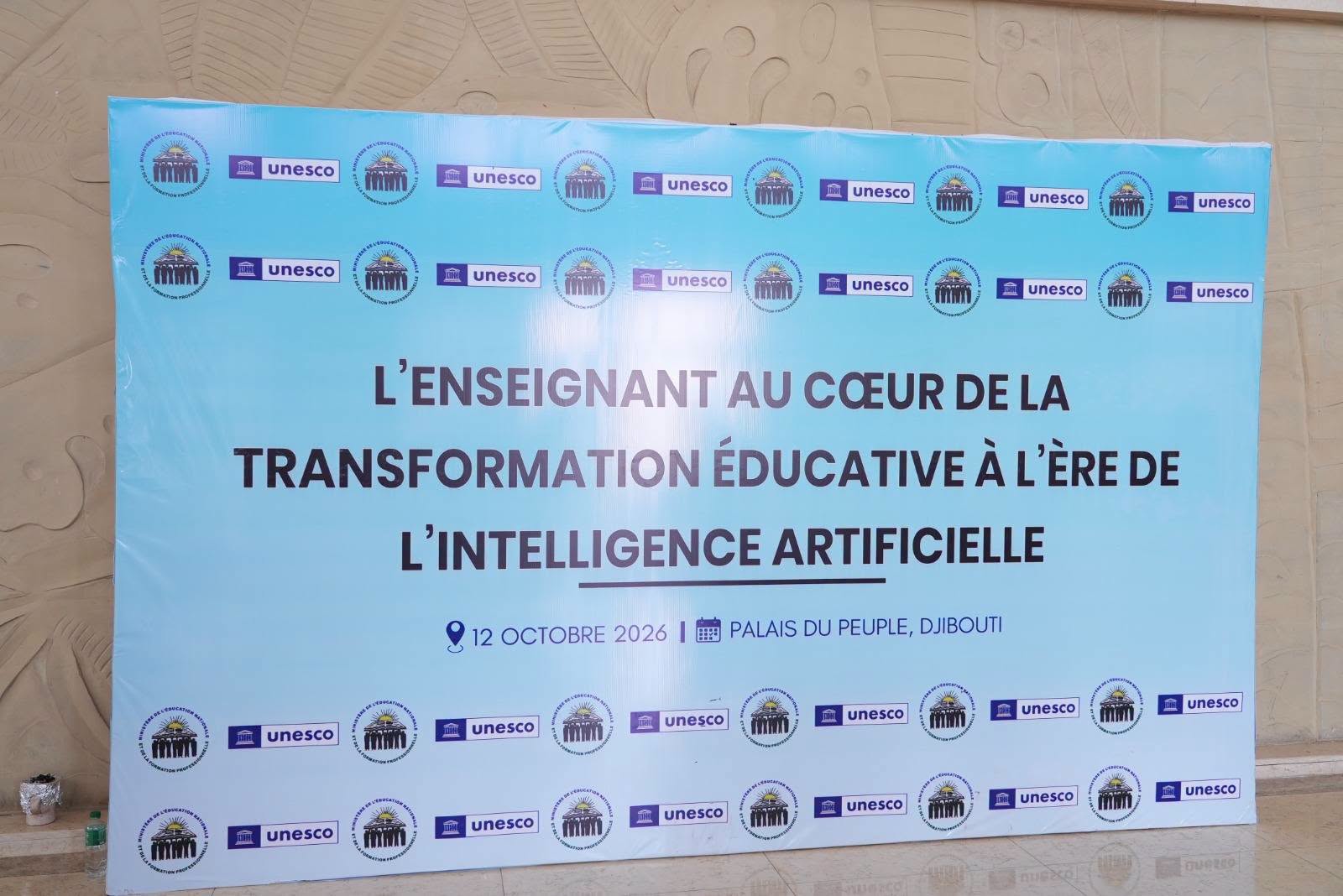
The reception and conference hall of the People’s Palace hosted today the closing ceremony of Teacher’s Week and the 2nd edition
The reception and conference hall of the People’s Palace hosted today the closing ceremony of Teacher’s Week and the 2nd edition of the National Day for Educational Innovation and Action-Research. The Minister of National Education and Vocational Training, Moustapha Mohamed Mahamoud, was joined by his colleagues Fardoussa Moussa Egueh and Fatouma Ali Abdallah, respectively Minister of Youth and Culture, and Secretary of State for Sports.

The event also brought together civil and military dignitaries, senior executives and officials from MENFOP, several hundred teachers, as well as handpicked guests. Placed under the theme "The Central Role of the Teacher in the Era of Digital Technology and Artificial Intelligence," this ceremony marked the end of a long week rich in activities and events related to this topic across a series of schools nationwide. Following a very warm welcome, the event proceeded with the sacred rituals of Holy Quran verses and the national anthem, sung in unison by the entire hall.
Dr. Mohamed Ahmed Issa, known as Aboyta Amoyta, then delivered an update on behalf of the scientific committee regarding the selected papers. The committee focused on the pedagogical use of digital technology and artificial intelligence in schools. He expressed great enthusiasm and hope regarding the promises of AI for improving children's learning in schools. Following his remarks, a recap video of Teacher's Week activities was screened to share the discoveries and learnings of the week.

This set the stage for sharing innovative experiences regarding educational transformation through Artificial Intelligence. In this regard, several short films were projected and presentations were delivered by teachers. These covered the playful use of AI in preschools, AI as a tool for teachers, AI-powered downloadable revision applications, and the use of AI to support formative assessment. The presentation series concluded with ERI Abaytou from Dikhil, a finalist in Djibouti for the "My Innovation in 120 Seconds" competition, which focused on the topic "From Written Nursery Rhymes to Cartoons." A final video on the "My Innovation in 120 Seconds" theme was then shown.

Official Speeches Followed by Certificate Presentations and a Social Gathering
Dr. Houssein Ahmed Assoweh, Director of the Mathematics and Digital Research Center at the University of Djibouti and an AI specialist, delivered an extensive speech on AI. He emphasized the absolute necessity of choosing the right generative AI tools and warned against AI approximations, stressing that it can never replace the teacher, who remains the control tower and validator of student achievements. He especially called for extreme vigilance regarding the impact of AI on education, pedagogy, and ethics. This speech was followed with great interest by the audience.

The UNESCO Representative to Djibouti, Mrs. Idyle Moussa Iyeh, praised MENFOP's commitment to pedagogical innovation, while reminding the audience that artificial intelligence must remain at the service of teachers and learning. She presented the AI competency frameworks developed by UNESCO for teachers and students, and reaffirmed the Organization's support for national educational reforms, notably through the drafting of the National Teacher Policy and the Teacher Code of Ethics and Conduct. Finally, she highlighted the importance of a responsible, inclusive, and ethical integration of AI within the Djiboutian educational system.
Saving the best for last, the Minister of National Education and Vocational Training, Moustapha Mohamed Mahamoud, concluded the official speeches. His address highlighted the central role and essential nature of the teaching profession in an era of digital transformation, alongside the immense challenges posed by the arrival of AI in schools. He paid tribute to the teacher, who will always remain the cornerstone for successfully driving digital and pedagogical transformations and innovations. Extensive excerpts from the Minister's speech are available in this newspaper.
Following the official speeches, certificates were presented to the participants of the presentation competition on the challenges of AI in schools. Afterward, a lavish lunch was offered to all participants.
Panels and Discussions
Following the official ceremony, several panels were organized to exchange ideas on themes related to educational innovation in the era of AI. Three panels, led by experts and teachers, focused on a series of topics centered around educational transformation through AI.
A first panel examined AI and the professional development of educational stakeholders. It focused on how AI transforms teachers' tasks and skills. Mr. Houssein Abdi Ahmed from the Yoboki primary school in Dikhil suggested potential approaches to this issue. Next, Mrs. Fatouma Daoud Omar from the School of Excellence studied the question of generative AI training through instructional design. Finally, Dr. Mahmoud Mohamed Abdi, a trainer at CFEN, offered insights into developing teachers' pedagogical intelligence in the AI era. Additionally, a central question for the primary Arabic language unit of CFEN was examined, namely the AI training needs for primary school Arabic teachers.

A second panel focused on AI ethics, inclusion, and governance. It was led by Mr. Ramahandry Lalasoa from the Gabode Technical High School, who suggested ideas on adapting resources with AI to make learning more accessible. Mr. Idriss Zinoua Hachem, a teacher-researcher at the Aboubaker Al Sidik private Arabic-speaking school (EduTrust RAG), demonstrated how to verify sources and maintain human supervision in AI usage. Finally, Mohamed Hassanle Walho from the EBT of Tadjourah studied the design of resources for young children under supervised AI use.

The third panel explored AI through the lens of Innovation and Action-Research. Faycal Omar Doualeh, a trainer at CFEN, studied the design of an early warning system for school dropouts to trigger support interventions. His colleague Mohamed Nour Weirah, also a trainer at CFEN, examined the design of an adaptive platform for students with special educational needs. Mr. Wilsan Mahdi Moussa from the OBOCK 1 primary school proposed an AI QUIZ to organize collective activities with limited equipment. Finally, Ismael Guedi Allaleh introduced "SimuGénie-AI" to foster collaboration across technical fields.

The three panels fueled discussions and exchanges throughout the afternoon. A synthesis and a list of recommendations were then drafted from this long session of exchanges and reflections. The Secretary-General of MENFOP, Mohamed Abdallah Mahyoub, officially closed the discussion panels late in the afternoon.
Share this article